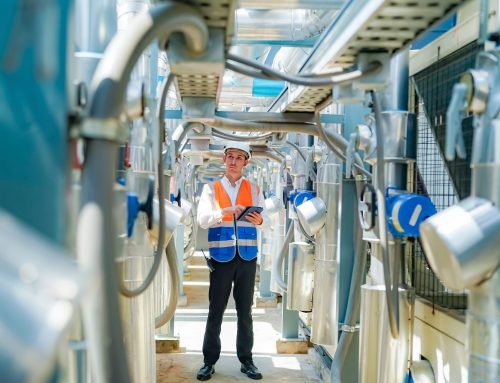

In today’s industrial landscape, digitalization is no longer a trend but an operational necessity. However, in many facilities we still encounter a very specific reality: systems that work well individually but are not connected to each other. Lighting, for example, is often still a system that symply switches on and off, with no capacity to adapt or provide information.
In this context, an industrial IoT platform makes it possible to go one step further. It is not just about connecting equipment, but about integrating data, managing assets, and, in the case of lighting, moving from a static system to a dynamic one capable of adapting to the plant’s actual operations.
From auxiliary system to technological infrastructure
Traditionally, industrial lighting has been a passive system. It is present throughout the facility but does not provide information or control capabilities.
Today, this approach is changing. Lighting can become a distributed technological infrastructure capable of supporting sensors and communications within an industrial IoT platform.
In addition to its role as a support for sensors, lighting enables the incorporation of an operational control layer. The ability to regulate output levels, create scenes, or adapt start-up based on real plant activity introduces a direct improvement in efficiency and facility usage. In practice, this means that lighting no longer responds to fixed shedules but instead behaves according to what is actually happening in the plant.
This approach allows solutions to be deployed without creating new networks, avoiding additional wiring, and reducing implementation complexity. In demanding environments such as ATEX zones, this advantage is particularly relevant, as it minimizes interventions and operational risks.
What an industrial IoT platform must offer in real environments
Not all IoT solutions are ready for industrial use. An industrial IoT platform must be robust, scalable, and capable of integrating with existing systems.
Above all, it must be useful. In other words, it mus enable the transformation of data into decisions.
In practice, this involves:
- Monitoring key variables in real time
- Detecting deviations before they lead to failures
- Reducing unnecessary interventions
- Improving energy efficiency
- Increasing operational safety
In sectors such as chemicals, oil&gas, or bulk logistics – where many facilities operates in ATEX zones – these capabilities make a real difference.
Atenea: a lighting-based industrial IoT platform
Atenea is an indsutrial IoT platform designed for demanding environments, including ATEX zones, which uses lighting as a technological infrastructure to deploy a distributed monitoring network. Its approach is based on a key idea: transforming each luminaire into a data collection node without modifying the existing installation.
In addition to this monitoring capability, Atenea enables advanced lighting control and management, allowing the creation of scenes, regulation of light ouput and adaptation of switching based on schedules, presence, or operational needs. In this way, lighting evolves from a static system into a dynamic element within the facility. For example, lighting zones can be defined dynamically so they can be controlled simultaneously without rewiring the electrical panel.
To achieve this, it integrates sensors associated with luminaires capable of measuring variables such as temperature, vibration, presence, or energy consumption. This data is transmitted wirelessly to a central platform where it is visualized, analyced, and converted into actionable information. This approach enables the deployment of an IoT solution without additional wiring or complex interventions – something especially relevant in industrial environments where any modification involves costs, risks or production downtime.
Moreover, Atenea not only provides real-time monitoring capabilities but also facilitates anomaly detection, automatic alert generation, and integration with other industrial systems, enabling the transition toward predictive maintenance models. Ultimately, it transforms ATEX lighting into an intelligent network that improves operational efficiency, reduces unnecessary interventions, and increases safety in complex industrial facilities.
Monitoring, maintenance and reduction of interventions
One of the main contributions of an industrial IoT platform is its impact on maintenance.
With access to real-time data, it becomes possible to anticipate failures, identify usage patterns, and optimize intervention planning. This enables the transition from a reactive model to a predictive one.
In many facilities, a common issue is that lighting remains at 100% regardless of actual usage. This not only impacts energy consumption but also the lifespan of equipment. Integrating control within an industrial IoT platform allows operation to be adjusted to real conditions, reducing consumption, and extending the life of luminaires.
In industrial environments – especially in ATEX zones – reducing the number of interventions is key. Each action involves costs, time, and operational risks.
Impact on energy efficiency and safety
Beyond maintenance, an industrial IoT platform has a direct impact on energy efficiency and safety.
Monitoring consumption makes it possible to optimize lighting usage and reduce the facility’s energy footprint. At the same time, the ability to detect activity, analyze patterns and generate alerts improves operational control.
In environments where safety is critical, such as ATEX zones, this real-time control capability provides a clear added value.
An industrial IoT platform is not just about connecting devices, but about transforming how a facility is managed.
Taking advantage of lighting as a technological infrastructure makes it possible to deploy a data network without increasing complexity of intervening in the installation. This is particularly relevant in demanding environments such as ATEX zones.
In this context, solutions like Atenea demonstrate that industrial digitalization is not always about adding more technology, but about using the technology already in place in a smarter way. Turning lighting into a data network—and into an active control system—makes it possible to improve efficiency, reduce interventions and gain visibility over the installation without increasing its complexity.
Miguel Ángel López – Project Manager (R+D & IIoT Solutions)