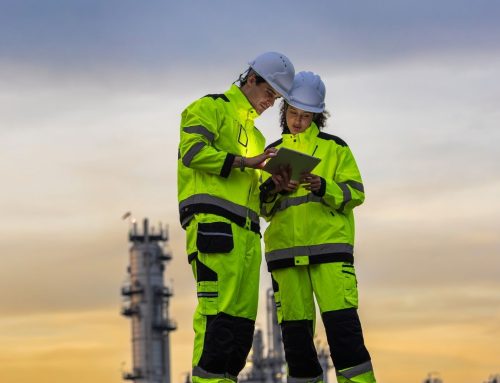

Hydrogen is becoming established as a key energy vector in industrial decarbonization, especially in applications where direct electrification alone does not meet process, storage, or energy transport requirements. Its development is accelerated by its role in the future integration of renewables, the production of synthetic fuels, and the reduction of emissions in energy-intensive sectors.
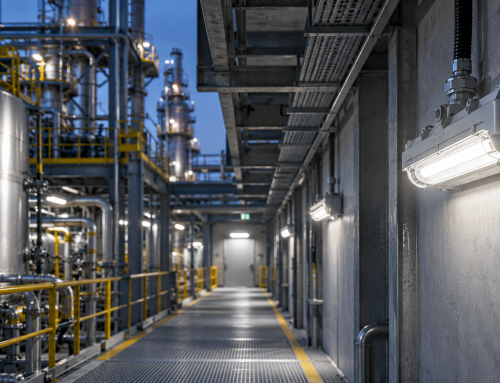
In Spain, this progress is already taking shape through large-scale investments and projects, increasing the need to design facilities with ATEX criteria from the outset. In this context, lighting becomes a technical safety element rather than a secondary decision.
Hydrogen belongs to Group IIC, the most demanding level within the ATEX classification, due to its low ignition of energy and particularly volatile behavior. This combination means that even small leaks can result in an explosive atmosphere if the installation is not properly designed. In this context, every design decision matters and must meet the same level of technical and operational requirements.
Why hydrogen plants are so demanding
Talking about Group IIC means talking about the most severe ATEX environment for gases. This category includes substances such as acetylene, as well as hydrogen, which require equipment specifically designed to prevent a spark, a hot surface or an insulation failure from becoming a source of ignition. This is critical because the gases included in this group have very low minimum ignition energies, very wide explosive concentration ranges and auto-ignition temperatures ranging from 90°C for carbon disulphide to 560°C for hydrogen, with acetylene at 305°C.
All this information relating to each installation makes it necessary to precisely control the surface temperature of any equipment installed. In practice, this directly affects the luminaire, but also junction boxes, cable glands, and accessories. A product suitable for other gases is not always suitable for hydrogen, even if it carries ATEX marking.
In addition to its auto-ignition temperature and extreme volatility, it should also be taken into account that hydrogen is extremely difficult to “contain” in tanks and that leaks, however minimal, are always present.
How ATEX zoning is applied
Zoning defines where an explosive atmosphere may appear and how frequently. In simple terms, Zone 0 is where the presence of gas is continuous or very prolonged; Zone 1, where it may occur under normal operating conditions; and Zone 2, where it would only occur occasionally or under abnormal conditions.
In a hydrogen plant, electrolysers, compressors, storage areas, and transfer points do not behave in the same way from an ATEX perspective. This means the luminaire must be adapted to the specific area: lighting an outdoor perimeter is not the same as lighting a technical area close to a potential leak point. Choosing the right zone is just as important as choosing the right equipment.
What a luminaire for hydrogen must comply with
A luminaire suitable for hydrogen must be certified for IIC, not just for a generic ATEX category. It must also incorporate a temperature class consistent with the gas auto-ignition temperature and with the safety margin required in the project.
The protection concept also matters: solutions such as Ex db, Ex eb or Ex ec may be suitable depending on the zone and the design of the installation. This is in addition to the degree of protection against dust, moisture and washing, where IP66 is usually a solid benchmark in industry and, for example, mandatory for Ex db. Installing a luminaire outside specification not only adds operational risk; it also compromises the plant’s legal compliance.
Mistakes to avoid
- Confusing IIA or IIB with IIC. Equipment suitable for gases is not automatically suitable for hydrogen
- Choosing an insufficient temperature class. If the surface temperature does not leave a safety margin, the risk increases unnecessarily
- Use “ATEX” luminaires without checking the full marking. The certification must clearly indicate its suitability for hydrogen (IIB + H2 or IIC)
- Ignoring the reality of outdoors areas. In hydrogen plants, zoning also affects platforms, walkaways and areas close to process equipment
Airfal’s proposal
Airfal develops ATEX lighting solutions designed for demanding industrial environments, with options suitable for Group IIC and protections such as IP66, aimed at plants where reliability and safety are non-negotiable. Its proposal is particularly well suited to hydrogen projects thanks to its combination of certification, strength, and practical approach to installation and maintenance.
For engineering firms, project managers, and safety managers, this means having a supplier that understands the logic of the plant, not just the catalogue.
If defining a green hydrogen project, it is worth reviewing the zoning and luminaire selection with Airfal’s technical team at clientes@airfal.com or by phone on +34 976 185 809

IVÁN CID – Engineering and Innovation Leader