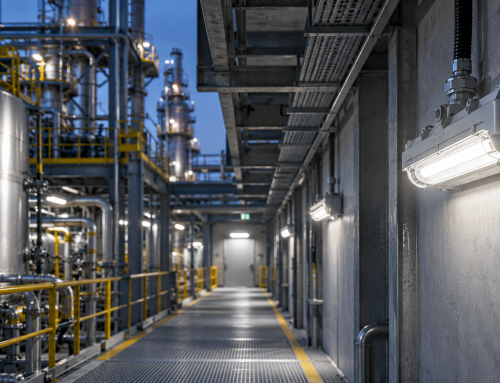

In an industrial plant, unexpected failures are not just a technical problem: they are a problem of production, safety and cost. When a luminaire stops working at the wrong moment, the consequences extend far beyond simply replacing a unit. In practice, however, lighting remains one of the systems that receives the least attention within industrial maintenance plans. It gets checked when it fails, not before.
This article explains how industrial luminaires actually degrade, what signs indicate that a unit is about to fail and why active monitoring is today the most effective tool for anticipating unplanned interventions, especially in environments with ATEX zones.
Why preventive maintenance of industrial luminaires reduces operating costs
Most unplanned downtime in industrial facilities carries a cost that goes far beyond the faulty part. An emergency intervention means staff available outside the usual schedule, possible shutdown of the affected area, urgent management of the spare part and, in ATEX environments, compliance with all the safety procedures that an unplanned intervention makes more difficult.
The most important point, however, is that there are almost always warning signs beforehand. A unit does not fail suddenly: it degrades. And that degradation, if interpreted in time, can be turned into a planned intervention, within the regular maintenance shift, without affecting production and without emergency costs.
Preventive maintenance of industrial luminaires is not about inspecting units at random: it is about understanding how they fail, identifying the early signs and acting before the problem becomes visible.
How an industrial luminaire degrades: what happens inside
A well-specified industrial LED luminaire can have a service life of more than 50,000 hours. But that does not mean it performs the same throughout that entire period, or that it reaches those hours without signs of deterioration.
The most vulnerable component is not the LED chip, which is usually the most robust part of the assembly. The critical point is the driver, the electronic circuit that regulates the unit’s current and voltage. The driver continuously absorbs the impact of heat, voltage fluctuations and humidity, and it is the first to show wear. The degradation is gradual, predictable and, with the right instruments, can be anticipated.
The three most common failure modes in industrial luminaires
The experience accumulated across industrial lighting projects makes it possible to identify three failure patterns that recur regardless of the sector:
- Thermal degradation of the driver. An operating temperature sustained above the design range significantly shortens the driver’s service life. It occurs especially in luminaires installed in poorly ventilated areas or exposed to external heat sources.
- Gradual loss of luminous flux. As LED chips age, their performance declines. The drop in illuminance in a work area can go unnoticed if it is not measured periodically, but it has a real impact on operational safety and on compliance with the lighting plan.
- Moisture ingress through compromised sealing. In harsh environments, the integrity of the sealing gaskets deteriorates over time. Moisture inside the enclosure accelerates the corrosion of electronic components and can compromise the IP rating or, in ATEX luminaires, the unit’s certification conditions.
Visible signs that a luminaire is failing
Some signs of deterioration can be observed directly during maintenance rounds or normal operation. Knowing how to interpret them correctly makes it possible to act before the failure becomes total:
- Intermittent flickering: usually indicates instability in the driver or problems in the electrical connections. It is not always visible to the naked eye, but it can be detected through direct observation or with measuring instruments.
- Change in the colour of the light: a perceptible variation in colour temperature compared with adjacent units may signal chip degradation or alterations in the driver.
- Perceptible reduction in intensity: if an area of the facility looks visibly darker with no apparent external cause, the unit may be losing luminous flux at an accelerated rate.
- Slow start-ups or spontaneous shutdowns: these indicate problems in the driver’s internal electronics and foreshadow a total failure within a limited time horizon.
- Partial malfunction of a segment of the LED chips, or a variation in intensity relative to the rest of the light-emitting line.
Each of these symptoms points to a different failure mechanism. Documenting them systematically and linking them to the unit’s history is the first step toward truly preventive maintenance.
Invisible signs: what you cannot see but can measure
The earliest symptoms of an imminent failure are not visible. They are parameters that can only be detected through active measurement and, in the most advanced systems, through continuous monitoring:
- Elevated surface temperature: a rise in temperature on the luminaire’s enclosure above the usual operating ranges indicates a heat-dissipation problem or an overload in the driver. In ATEX luminaires this parameter is critical: the maximum surface temperature is part of the unit’s certification, and exceeding it can compromise safety in a classified zone.
- Energy consumption outside the normal range: a driver that begins to degrade changes its consumption before the failure becomes visible. Comparing actual consumption with the unit’s nominal value is one of the most reliable indicators of early deterioration.
- Anomalous driver behaviour: variations in the dimming curve, loss of response to control commands or irregular on/off cycles are clear signs that the component is about to fail.
This is where monitoring comes in as a genuine diagnostic tool, not as an add-on technology but as part of the maintenance system itself.
Reactive maintenance vs. preventive maintenance: the real cost of each approach
Replacing a luminaire when it fails costs more than detecting the problem beforehand. The cost of the part is practically the same in both cases, but the context in which the intervention takes place changes everything else.
A planned replacement can be built into a scheduled maintenance shift, with the materials prepared and the staff assigned. An emergency replacement means detecting the failure, identifying the affected unit, locating the spare part, mobilising staff and carrying out the intervention under urgent conditions. In ATEX zones, where every intervention requires following specific safety procedures, the difference in time and cost is especially significant.
On top of this comes the impact on operations: an area without adequate lighting can mean reduced activity or, outright, the temporary shutdown of the affected area. In continuous-process facilities, the cost of that shutdown can far exceed that of any repair.
How IoT monitoring changes the equation
Connected lighting systems make it possible to record in real time the key parameters of each luminaire: operating temperature, accumulated operating hours, energy consumption and driver status. When those values deviate from the range defined as normal, the system generates an alert before there is any visible symptom.
This approach transforms lighting from a passive system into a source of operational information. Instead of waiting for a unit to fail, the maintenance manager receives the information far enough in advance to plan the intervention at the most convenient moment.
In environments with ATEX zones, the advantages are especially relevant. An unplanned intervention in a classified zone does not only carry an operational cost: it has safety implications that require coordination with the health and safety team, the application of specific procedures and, in many cases, the temporary shutdown of the area. Anticipating that scenario is not just efficiency: it is risk management.
Atenea, the lighting monitoring and control platform developed by Airfal, is designed specifically for this type of facility. It makes it possible to remotely supervise the status of each luminaire, receive alerts when parameters deviate and generate maintenance reports without the need for periodic physical inspections in the highest-risk areas. Reducing physical presence in classified zones is not only an operational advantage: it is a direct improvement in safety.
The best intervention is the one you never have to make in an emergency
A luminaire that is well specified for its operating environment, correctly installed and actively monitored should never appear in the corrective maintenance plan. Degradation exists, but it is predictable. Failures are inevitable in the long term, but their operational impact is not.
Preventive maintenance of industrial luminaires does not require large upfront investments: it requires methodology, data and the will to move from reacting to anticipating. In plants with ATEX zones, where every intervention carries greater weight, that anticipation is part of the safety strategy, not just the efficiency plan.
If you want to review the condition of your lighting system or explore how to integrate monitoring into your facility, our technical team can help you assess the options best suited to your plant.
CARLOS JIMÉNEZ – ATEX Engineering